

Research & Collaboration
What makes us unique?
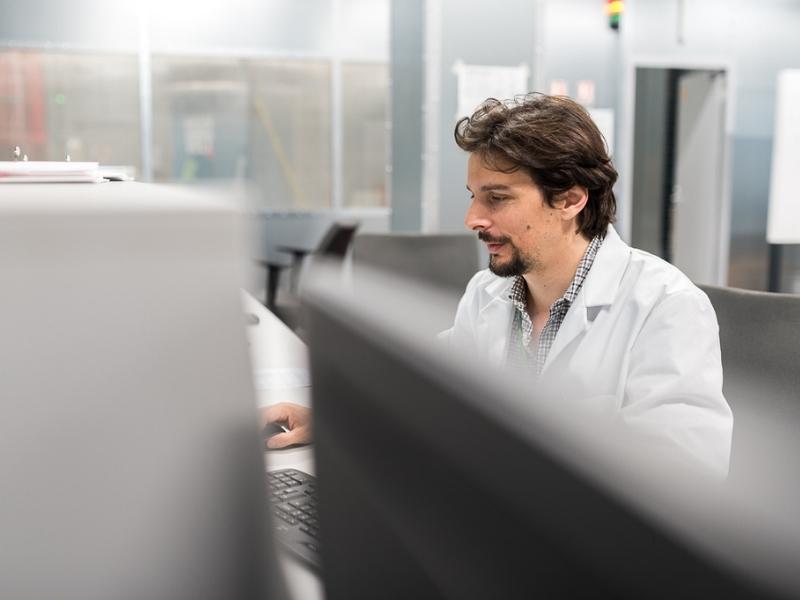
SuperGrid Institute owes its success to the people who make up our various research departments. Our teams come from diverse backgrounds in industry and academia, and their wealth of experience and skills make the Institute unique. Each individual brings specific expertise to the table.
This melting pot of knowledge offers opportunities for specialists from different fields to collaborate on new and innovative solutions to technical problems.
The Institute also benefits from close collaborative relationships with industry and academic institutions. The complementary strengths of our partners provide insights and innovative approaches to technical challenges. At the same time, we retain total independence in our research. Public-private investments and collaborative projects finance our work.
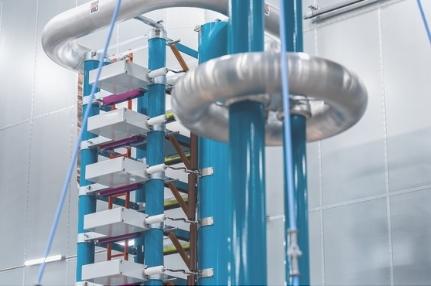
SuperGrid Institute’s state-of-the-art research facilities, test platforms and laboratories at the Villeurbanne and Grenoble sites are key to the success of our five research departments.


Latest scientific publications
Protection strategy for MTDC grids using SFCLS at converter station output
This study proposes a non-selective protection strategy for multi-terminal high voltage direct current grids based on resistive-type superconducting fault current limiters (SFCLs). Located at the output of AC/DC converters, the SFCL limits the current contribution from the AC grid in case of DC fault. With this approach, the fault clearing time constraint is relieved allowing the use of mechanical DC circuit breakers for fault current interruption. Furthermore, the breaking capability and energy dissipation requirements of the breaker are greatly reduced. To achieve a fast restoration of the DC grid, a redundant SFCL is introduced in parallel to those in operation, bypassing them when the fault is effectively suppressed. In addition, primary and back-up protection schemes are described and tested using a three-terminal bipolar HVDC grid based on half-bridge modular multilevel converters and cable transmission. Simulations are implemented in EMTP-RV® to analyse and discuss performances of the proposed fault clearing strategy.
Evaluation of HVDC cable impedance and admittance matrices by finite element method
In this work, a 2D Finite Element Method (FEM) is used to calculate the frequency dependent impedance and admittance matrices of underground and submarine cables. A harmonic magnetodynamic formulation is used to calculate the series impedances, and for the calculation of the parallel admittance an electrodynamic formulation is applied.
Robustness study of 1700 V 45 mΩ SiC MOSFETs
The threshold voltage instability is a main reliability issue of Silicon Carbide MOSFET transistors. It is a critical parameter when it comes to give a failure in time rate for industrial power applications. In this context, a static ageing test based on JEDEC standard is proposed and the resulting gate oxide degradation is studied and discussed in this paper.