
Research & Collaboration
What makes us unique?
SuperGrid Institute owes its success to the people who make up our various research departments. Our teams come from diverse backgrounds in industry and academia, and their wealth of experience and skills make the Institute unique. Each individual brings specific expertise to the table.
This melting pot of knowledge offers opportunities for specialists from different fields to collaborate on new and innovative solutions to technical problems.
The Institute also benefits from close collaborative relationships with industry and academic institutions. The complementary strengths of our partners provide insights and innovative approaches to technical challenges. At the same time, we retain total independence in our research. Public-private investments and collaborative projects finance our work.
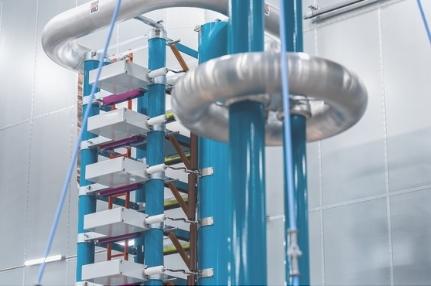
SuperGrid Institute’s state-of-the-art research facilities, test platforms and laboratories at the Villeurbanne and Grenoble sites are key to the success of our five research departments.

Latest scientific publications
Characterization and tests of the HTS tape and the preliminary pancake for the RSFCL of the SCARLET project
Characterisation of HTS tapes and a first superconducting pancake coil for an RSFCL developed within the SCARLET project.
An optical magnetometer toward measurements of low current magnitudes for high voltage power transmission applications
A Zeeman-effect magnetometer measures magnetic fields from leakage currents in HVDC cable insulation, supporting insulation condition assessment.
Surface Charge Measurements in Non-Uniform Pressurized Air Gaps with a Dielectric Barrier
Surface charge measurements investigate dielectric barrier behaviour in pressurized air gaps, supporting compact SF₆-free GIS design.