

Research & Collaboration
What makes us unique?
SuperGrid Institute owes its success to the people who make up our various research departments. Our teams come from diverse backgrounds in industry and academia, and their wealth of experience and skills make the Institute unique. Each individual brings specific expertise to the table.
This melting pot of knowledge offers opportunities for specialists from different fields to collaborate on new and innovative solutions to technical problems.
The Institute also benefits from close collaborative relationships with industry and academic institutions. The complementary strengths of our partners provide insights and innovative approaches to technical challenges. At the same time, we retain total independence in our research. Public-private investments and collaborative projects finance our work.
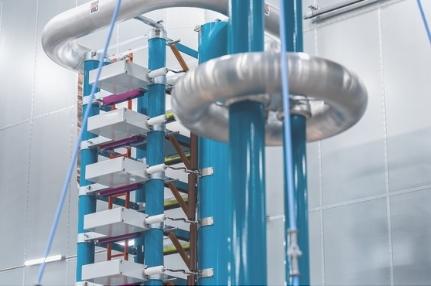
SuperGrid Institute’s state-of-the-art research facilities, test platforms and laboratories at the Villeurbanne and Grenoble sites are key to the success of our five research departments.

Latest scientific publications
Design considerations for the 2- phase cooling system of a 5 MW MVDC converter
This presentation will provide an update on our current project: designing a cooler for a high power (5 MW) MVDC converter for offshore wind turbines applications. A number of constraints are imposed, mainly related to a limited volume, environmental, safety and health regulations, and of course cooling performance. Indeed, as we presented last year (ATW 2017), the silicon carbide power semiconductors used in this converter should operate at a junction temperature lower than 100 °C for better efficiency.
Analysis of the Lower Limit of Allowable Energy in Modular Multilevel Converters
In this paper, a thorough analysis of the converter arm behavior is presented, which gives an analytic expression of the lower limit of the energy as a function of the converter operating point and the connected grid conditions. The relation between the lower energy limit and the operating power is analyzed by using the practical MMC specifications of an HVDC application. An experimental test of a small-scale MMC mock-up demonstrates the validity of the theoretical analysis.
Advanced Electrical characterisation of high voltage 4H-SiC PiN diodes
This paper reports the design, the processing, the static characterisation, the switching behaviour and the high current stress test of 10 kV aimed 4H-SiC bipolar diodes. The actual breakdown voltage of the selected devices is between 7 kV and 8 kV. The switching characterisations show a good behaviour with a t rr of only 90 ns. No degradation was observed after the application of 10 000 high current pulses during the stress tests.