

Research & Collaboration
What makes us unique?
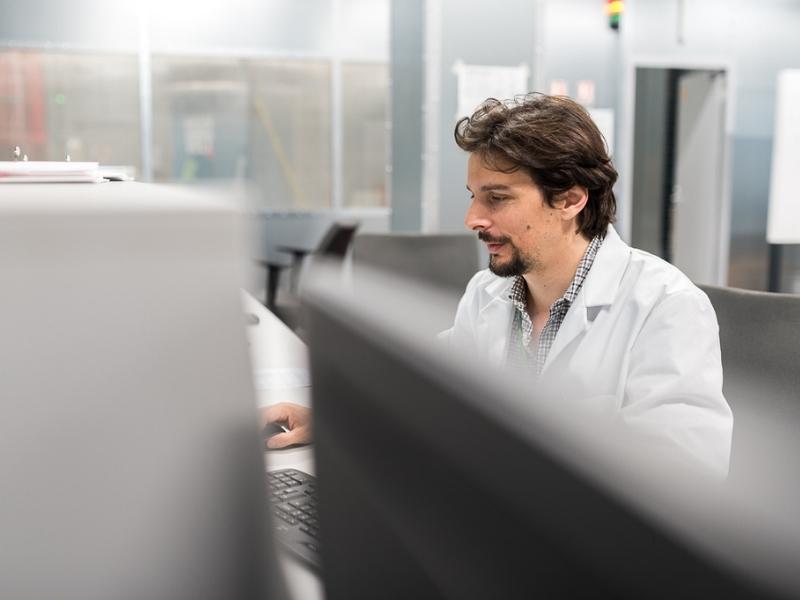
SuperGrid Institute owes its success to the people who make up our various research departments. Our teams come from diverse backgrounds in industry and academia, and their wealth of experience and skills make the Institute unique. Each individual brings specific expertise to the table.
This melting pot of knowledge offers opportunities for specialists from different fields to collaborate on new and innovative solutions to technical problems.
The Institute also benefits from close collaborative relationships with industry and academic institutions. The complementary strengths of our partners provide insights and innovative approaches to technical challenges. At the same time, we retain total independence in our research. Public-private investments and collaborative projects finance our work.
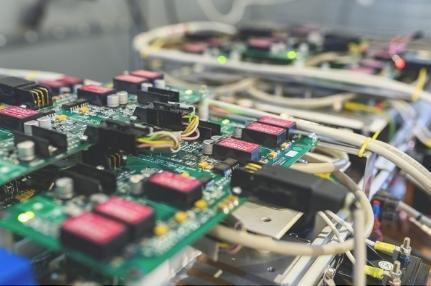
SuperGrid Institute’s state-of-the-art research facilities, test platforms and laboratories at the Villeurbanne and Grenoble sites are key to the success of our five research departments.


Latest scientific publications
Power Hardware In-the-Loop validation of DC-DC power converter for offshore wind energy
he paper describes the development of a power converter small scale mock-up and a real time model of an off-shore wind farm. A Power Hardware In-the-Loop validation is proposed for a demonstration of grid architecture and control principles. The paper presents the design methodology of the PHIL test bench and underlines the contribution of PHIL in the design flow of power converter development for DC grid application. Experimental results of preliminary PHIL tests are presented.
Influence of the operating frequency on DC-DC converters for HVDC grids
This paper proposes an analytical methodology that allows to assess rapidly the comparison of DC-DC converters. It was applied to evaluate two modular DC-DC structures, one isolated circuit and one non isolated circuit, focusing in the variation of the operating frequency for different DC voltage transformation ratios.
Tuning of Droop Parameters Using Virtual Capacitor Control to Improve Voltage Dynamics
This paper proposes a new approach to tuning voltage droop parameters in an MMC-based multi-terminal HVDC system. Using the new degree of freedom offered by the virtual capacitor control, the transient behavior of the DC voltage can be improved without adverse effects on the connected AC grids.