

Research & Collaboration
What makes us unique?
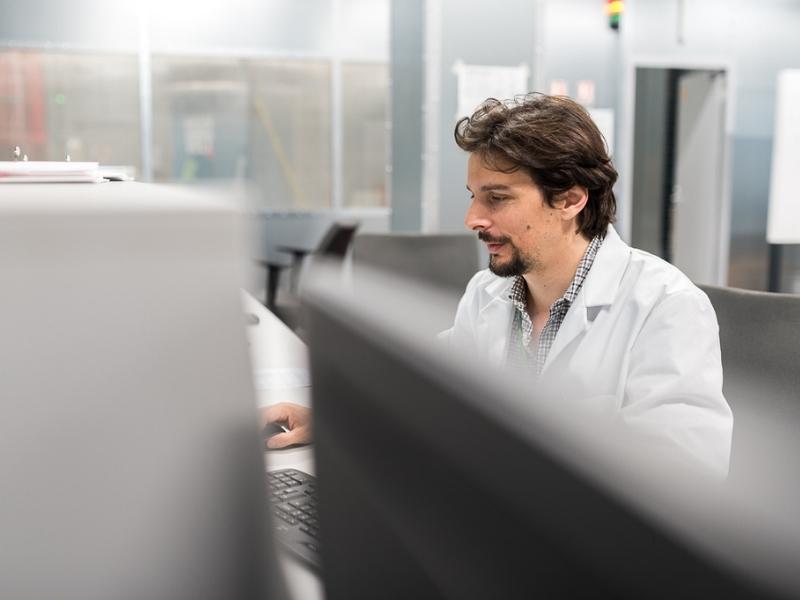
SuperGrid Institute owes its success to the people who make up our various research departments. Our teams come from diverse backgrounds in industry and academia, and their wealth of experience and skills make the Institute unique. Each individual brings specific expertise to the table.
This melting pot of knowledge offers opportunities for specialists from different fields to collaborate on new and innovative solutions to technical problems.
The Institute also benefits from close collaborative relationships with industry and academic institutions. The complementary strengths of our partners provide insights and innovative approaches to technical challenges. At the same time, we retain total independence in our research. Public-private investments and collaborative projects finance our work.
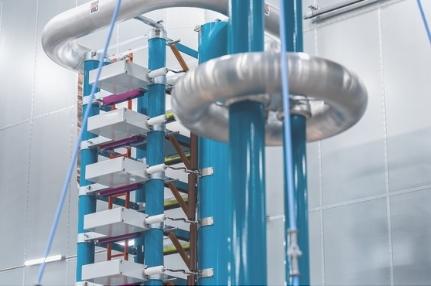
SuperGrid Institute’s state-of-the-art research facilities, test platforms and laboratories at the Villeurbanne and Grenoble sites are key to the success of our five research departments.

Latest scientific publications
Requirements for interconnection of HVDC links with DC-DC converters
The number of high voltage direct current (HVDC) links continue to increase over the years, most of them, for offshore applications or bulk power transmission over long distances. The present paper evaluates the possible development of a direct current (dc) grid in Europe given the present, and future, HVDC links. Eight potential cases for the interconnection between close links are suggested as starting scenario for a multiterminal network. The need of a dc-dc converter and its special requirements are evaluated in function of suggested interconnections. As an example, a case study is chosen to evaluate the behavior of an interconnection between line commutated converter (LCC) and voltage source converter (VSC) link using a front-to-front (F2F) isolated converter.
Assessment of the Impact of Split Storage within Modular Multilevel Converter
This paper deals with the opportunities to introduce split storage into an MMC. The analysis is focused on the internal energy exchange to maintain the proper function of the converter by using circulating current. Analysis shows that, SM capacitor voltage ripple or semiconductors load are greatly influenced by additional circulating current injection. This study helps to design Embedded ESSs in the converter to provide new function like ancillary services for power system operation. Finally, a simulation of an MMC with ESS confirms analytical calculations.
Interest of using a micro-meter spatial resolution to study SiC semi-conductor devices by Optical Beam Induced Current (OBIC)
In this paper we present a new test bench called micro-OBIC used to characterized wide band gap semi-conductor. Micro-OBIC allows to scan an Optical Beam Induced Current (OBIC) signal with a microscopic spatial resolution. We used micro-OBIC to characterize peripheral protection such as MESA, JTE or JTE in high voltage SiC device.