

Detection of partial discharge in cables using Distributed Acoustic Sensing (DAS)
Detecting partial discharge (PD) at an early stage is essential for maintaining the reliability and safety of power transmission systems. Their accumulation progressively degrades insulation and can eventually lead to complete failure.
SuperGrid Institute and FEBUS Optics conducted an experimental study on the use of Distributed Acoustic Sensing (DAS) for partial discharge detection in high-voltage power cables. Experimental results highlight characteristic spectral behaviours that allow discrimination between healthy and defective cable configurations.
FEBUS Optics, provider of distributed fiber optic solutions, had a simple but powerful idea: what if the optical fibers embedded in cables could be used to detect faults directly within the cables themselves? Optical fibers are already used in infrastructures, such as bridges, to monitor vibrations in real time. The same principle could be applied to high voltage cables: by linking the fibers to a Distributed Acoustic Sensing (DAS) system, developed by FEBUS Optics, to detect and quantify partial discharges directly within the cable.
This method provides a significant advantage for proactive maintenance and network safety. Unlike traditional techniques, this approach enables continuous monitoring of high-risk areas, particularly junctions and terminations, where issues are most likely to occur.
To test this concept, FEBUS Optics partnered with SuperGrid Institute, leveraging their deep expertise in partial discharges. “Together, we explored how optical fibers could serve a dual purpose: both transmitting signals and acting as real-time sensors for cable health”, explains Amjad Mouhaidali, project manager at SuperGrid Institute. “Where there are many partial discharges, it’s important to investigate what’s happening.”
This innovative approach could enable Transmission System Operators (TSOs) to monitor the cables more efficiently, detect potential issues early and ultimately improve reliability and safety. By closely monitoring junctions and terminations, the most critical points, it is possible to intervene before minor issues escalate into major failures.
Early partial discharge detection
Optical fibers, immune to electromagnetic interference, captures the signals emitted by partial discharges at a very early stage.
“Controlled experiments were performed on optical fibers wound on high-voltage test rolls containing various insulation defects, with simultaneous conventional partial discharge measurements for validation”, continues Amjad Mouhaidali.
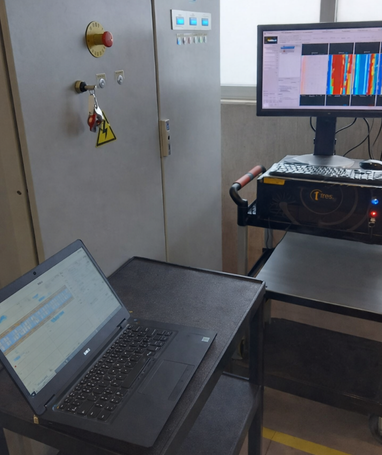
HV cable test platform with integrated heating and PD detection
For this study, SuperGrid Institute used its 100 kV AC & 400 kV DC test platform.
This facility is designed to test medium-voltage cables and their accessories under combined electrical and thermal conditions. It includes voltage and heating transformers, and it allows the testing of cable samples with lengths of up to 30 meters. The platform also provides a low level of partial discharge noise, below 2 pC, which enables reliable measurements for insulation assessment.
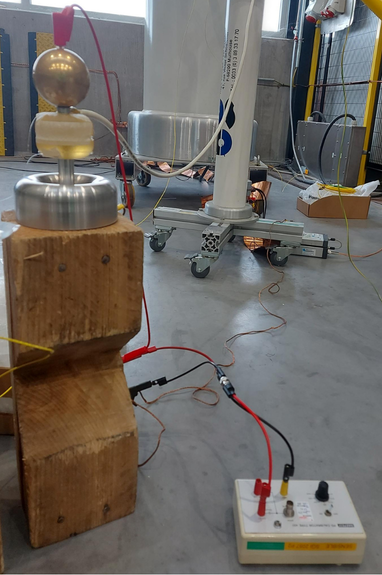
The test set up
Bare optical fibers, connected to a FEBUS A1 DAS interrogator, were wound onto high-voltage test coils, each connected to an AC power source. Seven rolls were tested: three defect-free rolls served as references, while four rolls contained specific insulation defects.
The FEBUS A1 DAS enabled distributed monitoring of dynamic events along the entire fiber length, with acoustic sensitivity typically ranging from a few hertz to a few tens of kilohertz depending on the monitored fiber length.
Acting as a series of virtual vibration sensors spaced every few meters, the interrogator continuously recorded acoustic activity along the cable under test.
Conventional electrical PD measurements (Omicron system) were simultaneously recorded by SuperGrid Institute, providing the applied voltage, apparent charge (pC), PD inception voltage and pulse count as reference data for validation.
The results
Experimental results demonstrated that the FEBUS A1 can provide direct qualitative information about partial discharge activity occurring along the optical fiber.
Frequency-domain analysis confirmed that PD activity is characterised by the emergence of a 50 Hz component and its harmonics, whereas the 100 Hz component mainly reflects the presence of the electrical power supply.
DAS measurements clearly differentiated healthy and defective cable configurations, demonstrating the capability of distributed fiber optic sensing to detect and track partial discharge activity at an early stage.
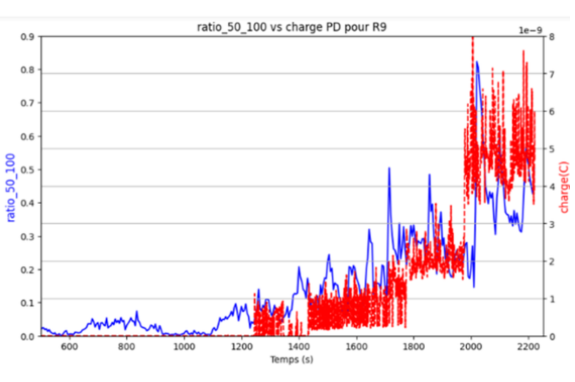
Ratio 50–100 vs PD charge: The red curve represents the PD charge as a function of time,
while the blue curve illustrates the evolution of the 50–100 ratio in the strain-rate signal.
The full scientific results of this work will be presented at the International Conference on Dielectrics (ICD).
Inspired by this use case? Let’s talk about your next project!
In-house HV test objects with introduce defects
The embedded electrodes of the project were developed by SuperGrid Institute material lab, who has a perfect grasp of the manufacturing process and knows how to introduce defects into it.
SuperGrid Institute’s materials expertise lies in the controlled encapsulation of electrodes within insulating media to accurately characterise intrinsic electrical properties. While this type of measurement technique is known in the field, SuperGrid Institute’s added value is twofold: first, in the precise design of the mold and test object (optimising insulating thickness, electrode geometry and overall configuration) and second, in the rigorous preparation of defect-free samples.


SuperGrid Institute’s in-house prototype sampling
“In the context of the project, ensuring the absence of unintended defects was critical, as even minor imperfections can significantly bias measurement results”, explains Anatole Collet, Material team leader. “Leveraging our knowledge of insulating materials, we selected a well-characterised resin and engineered test samples in the form of a wheel. We then went a step further by intentionally introducing controlled defects (such as protrusions or foreign inclusions) to study their impact.”
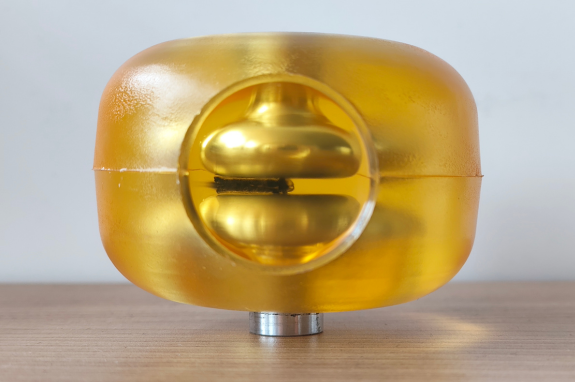
Electrical breakdown in the embedded electrode.
This process required a high level of precision, as isolating and reproducibly manufacturing a single, well-defined defect remains a complex technical challenge. This expertise is directly applicable to cable ecosystems, insulating materials and electrical engineering applications where material integrity is critical to performance and reliability.