
Solid-State Transformers:
Inside the Technology
Welcome back to our article series exploring the fundamentals of Solid-State Transformers (SSTs). In our last article, we addressed the basic questions of what a solid-state transformer is and why it matters for the future of power distribution. Now let us dive in deeper! What role do the SST's components play in making this technology efficient and compact? How can this flexible solution be used in different electrical architectures? Why are SSTs an important enabling technology for a sustainable energy future? Read on to find out!
Reminder: What is a solid-state transformer ?
At its simplest, a traditional transformer transfers electrical energy between circuits using magnetic fields. A Solid-State Transformer (SST) performs the same fundamental role but does so through advanced power electronics.
Instead of relying solely on heavy copper windings and iron cores, SSTs use semiconductor switches and high-frequency conversion technologies to precisely control energy flow. This not only makes them significantly more compact and efficient, but also allows for intelligent control, bidirectionality, and seamless integration across both AC and DC networks.
In essence, SSTs bridge the gap between the conventional grid and the smart, hybrid AC-DC power systems of the future.
Inside the Technology: From SiC to MFT
Two critical innovations make SSTs possible: silicon carbide (SiC) semiconductors and the medium-frequency transformer (MFT).
Silicon carbide (SiC) is a wide bandgap material that can handle higher voltages, frequencies and temperatures than traditional silicon. This allows devices built with SiC, such as MOSFETs, to switch faster and with lower losses, dramatically improving overall efficiency. In power conversion terms, that means reduced heat dissipation, smaller cooling requirements and a more compact footprint – exactly what next-generation substations and distribution systems need.
The medium-frequency transformer (MFT), meanwhile, provides galvanic isolation between input and output while operating at a much higher frequency than conventional 50 Hz equipment. Operating in the range of a few kilohertz, the MFT enables the physical size and weight of the transformer to drop drastically, while maintaining safety and electrical isolation. When combined with SiC-based switching stages, it forms the core of an SST's compact, efficient design.
Infinite SST possibilities: a highly adaptable technology for AC/AC, DC/DC and AC/DC architectures
One of the qualities that makes SST technology so interesting is that there is no one finite SST configuration. SSTs can be designed to function in multiple architectures (AC-to-AC, DC-to-DC, or AC-to-DC), voltages & currents by adapting the organisation of the high-frequency conversion and transformation stages.
- AC/AC conversion: In more traditional AC networks, SSTs can replace or complement conventional transformers while offering finer voltage regulation, dynamic control and the possibility to support grid-forming functions. This opens opportunities for resilient, decentralised power distribution-particularly in urban networks under growing electrical demand.
- DC/DC conversion: In HVDC or MVDC applications, SSTs enable voltage level conversion between different DC domains. This is especially valuable for large industrial processes, data centres and transport electrification. Their high-frequency operation and bidirectional capability make them ideal for future multi-terminal DC grids.
- AC/DC conversion: SSTs act as smart interfaces between legacy AC distribution infrastructure and emerging DC systems; connecting renewable energy generation, electric vehicle charging stations or data centres through a DC distribution microgrid). Their controllability enables active power management, reactive power support and improved fault management. In solar applications for instance, the AC/DC SST would replace both PV inverters and bulky conventional 50Hz AC transformers.
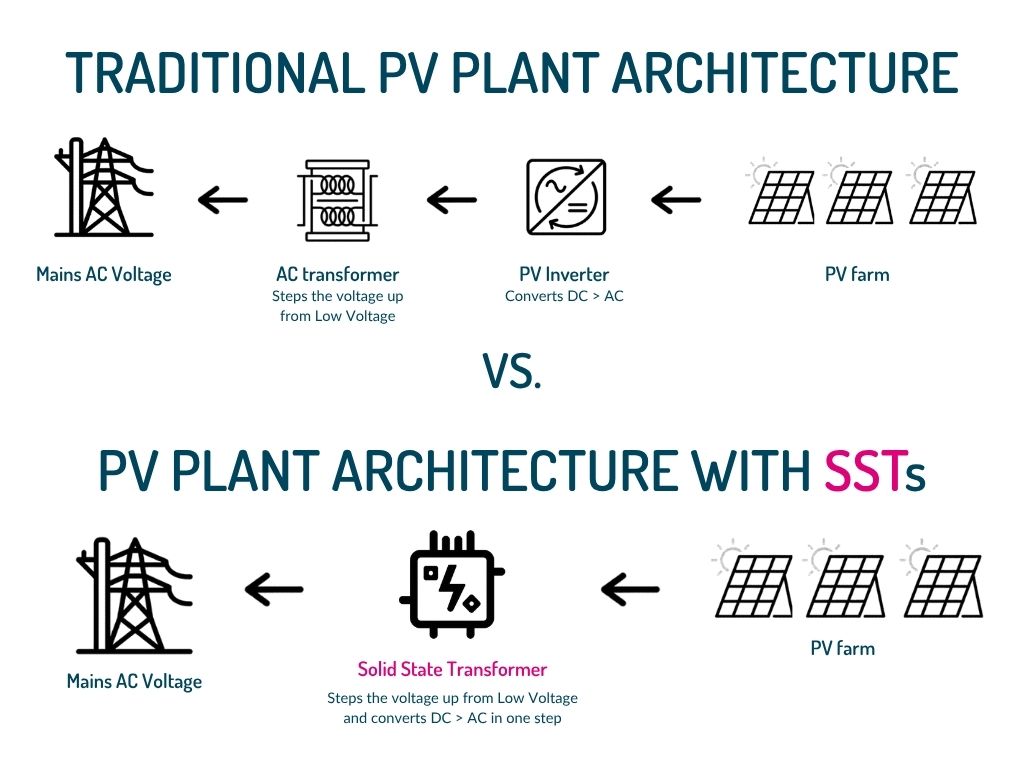
These configurations reflect how SSTs fit seamlessly across a spectrum of applications – from renewable integration to offshore transmission, and from charging infrastructure to DC distribution networks.
Why Solid-State Transformers Matter Now
The move toward digitalisation and decarbonisation demands new tools to manage a grid that is no longer one-directional or uniform. Unlike conventional transformers, SSTs don't just transfer power, they control it.
This intelligence brings several key advantages:
- Higher efficiency and a reduced footprint. By operating at medium frequencies and using SiC semiconductors, SSTs minimise energy losses and deliver lighter, smaller installations which require less copper – a resource which is becoming increasingly rare and fought over.
- Bidirectionality. Power can flow both ways, enabling energy prosumption (consumers who also generate power) and more dynamic grid operation.
- Enhanced protection and monitoring. SSTs can react almost instantaneously to faults or voltage fluctuations, improving grid resilience.
- Simplified integration with renewables and storage. With precise DC coupling, they streamline connections for solar arrays, batteries and EV charging stations.
- Smart control and connectivity. SSTs can be digitally controlled, providing real-time data and analytics for predictive maintenance and grid optimisation.
These attributes make SSTs an enabling technology for the smart, adaptive grids required to deliver a reliable, sustainable energy future. However, several challenges remain before establishing SST technology as reliable, industrially mature and economically viable solution.
Looking Ahead: A Deep Dive into SST Components
The attractiveness of SST technology will depend on the technological maturity of its components.
In our next article, we'll explore one of the SST's most critical components in detail: the Medium-Frequency Transformer (MFT). We'll discuss its role in achieving galvanic isolation, examine its design challenges, and showcase cases where SuperGrid Institute's R&D has delivered tangible performance gains.
Stay tuned to see how our expertise in MFT technology is helping make Solid-State Transformers a reality across multiple energy applications.