

The power of real-time simulation
for next-generation grid control
Electricity networks are changing faster than ever. As renewable generation, digitalisation and direct current (DC) technologies reshape power flows and the equipment it flows through, manufacturers and grid operators are working to ensure the stability, reliability and interoperability of power systems. Yet as these systems become more complex, new solutions must be validated and optimised long before they are deployed in the field.
That is where real-time grid simulation comes in. Factory acceptance tests (FAT) for power system controls allow engineers to test, refine and de-risk new or more mature grid control technologies in a fully controlled environment, bridging the gap between offline and real-world performances.
Understanding real-time simulation, HIL and PHIL
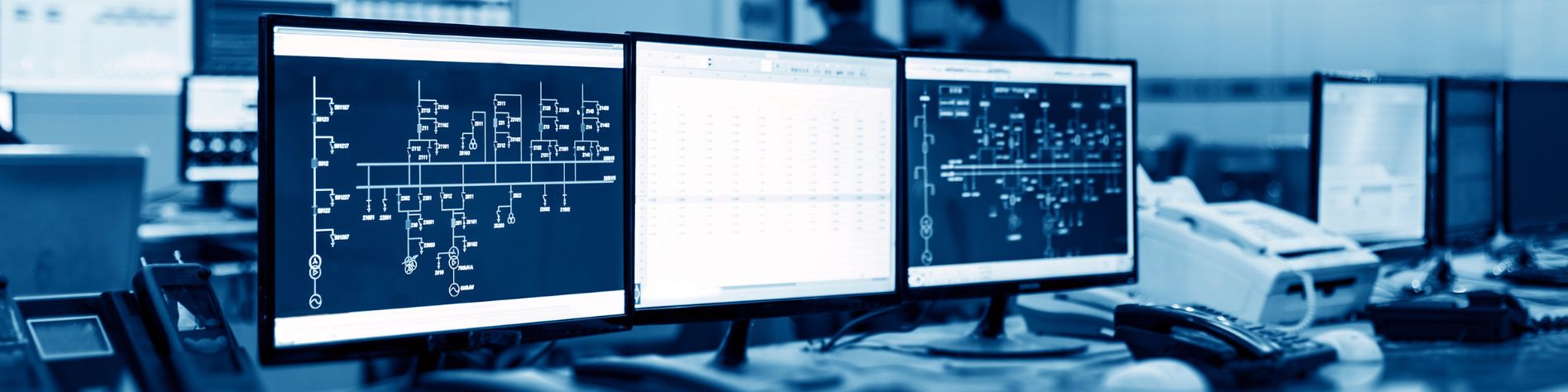
At its core, real-time simulation reproduces the dynamic behaviour of power systems in a digital environment that operates at the same pace as the physical world. Unlike offline simulation, where results are obtained after running a computational model, real-time simulators compute the response of a system continuously, step by step, in real time: 1 second of simulation = 1 second gone by in the real world!
Two techniques that extend this tool's reach are: Hardware-in-the-Loop (HIL) and Power-Hardware-in-the-Loop (PHIL) simulation.
- HIL simulation connects real control hardware – for example, the control board of a converter or protection relay – to a virtual power system model. The controller is involved in simulated conditions identical to an actual grid, allowing engineers to observe how control algorithms & communication protocols perform under a wide range of operating scenarios.
- PHIL simulation goes one step further by exchanging not just control signals but actual electrical power between the simulated environment and physical equipment under test. This enables testing of full-scale devices such as converter prototypes or circuit breakers, verifying electrical behaviour and control interactions under realistic conditions, without needing an entire network setup.
Together, these methods provide a safe, flexible platform to explore how emerging technologies behave before they reach the field.
Reducing risk in advanced power equipment integration
Modern medium and high-voltage equipment, such as power converters, flexible alternating current transmission system (FACTS) devices and DC protection devices, play a central role in accelerating grid modernisation. Yet each new component interacts with its surroundings in complex ways. Integration challenges often arise not because a device fails mechanically, but because its control and protection functions behave unpredictably within the larger system context.
Through HIL and PHIL simulation, these interactions can be studied long before commissioning. For a converter manufacturer, this means being able to:
- Validate control strategies under normal and fault scenarios (steady-state and transient conditions for both scenarios).
- Observe converter control effects on grid impedance, system harmonics or voltage dynamics.
- Optimise tuning protection settings without the risk of damaging expensive hardware.
For grid operators or system integrators, it means de-risking projects and building confidence in how new technologies will behave once connected to the live network.
A practical example is the validation of a new voltage source converter for a FACTS application. By linking the converter's actual control hardware to a real-time network model, engineers can test voltage regulation, fault response and communication timing across a wide variety of grid scenarios – all before a single piece of equipment is deployed.
Enabling the future of AC-DC grids by validating system level grid control
As power systems evolve beyond traditional alternating current (AC) architectures, high-voltage direct current (HVDC) networks are set to play a vital role, while medium-voltage direct current (MVDC) networks are emerging as promising enabling solutions. DC grids offer major benefits in long-distance transmission, offshore wind integration and urban power distribution. However, they also bring new challenges: the absence of natural frequency, faster transients and the complexity of controlling multiple converters interacting in real time.
Multi-terminal HVDC grids – where power flows can be controlled dynamically between several converter stations – require extremely reliable coordination and protection. The interoperability between converters from different manufacturers must be ensured to prevent instability or protection malfunctions.
Real-time HIL and PHIL simulation provides a unique environment to test and refine these advanced DC control strategies. By modelling entire DC networks, including detailed converter behaviour, engineers can:
- Simulate faults such as pole-to-pole short circuits and assess protection actions.
- Design and test coordinated control schemes between multiple converter stations.
- Verify interoperability between different converter technologies and communication protocols.
Through such simulation campaigns, manufacturers, developers and operators can accelerate innovation while reducing the cost and time of field trials – a decisive advantage in a rapidly evolving grid landscape.
From innovation to implementation
Real-time testing is more than just a validation tool; it acts as a bridge between research and deployment. It allows engineers to iterate faster, align control design with real operating conditions, and refine protection systems before they face live stress.
For decision-makers, investing in real-time simulation means shorter development cycles, fewer integration surprises and stronger evidence for regulatory and investment decisions. It transforms trial-and-error into measurable, data-driven engineering. What's more, because these simulations are flexible, they support both early-stage research and late-stage acceptance testing.
Building confidence in a dynamic grid future
At SuperGrid Institute, we specialise in developing and demonstrating control and protection solutions for AC-DC networks using high-performance real-time simulation platforms. By combining advanced modelling with practical testing, we help partners bridge the gap between concept and field deployment, ensuring every new technology contributes safely and efficiently to the grid of the future.
Interested in real-time simulation solutions for your next grid control project? Contact SuperGrid Institute to collaborate on reliable, future-proof power system validation.