

Assessing the security of future HVDC grids
with the open-source framework PowSyBl
As Europe moves towards multi-terminal and multi-vendor HVDC infrastructures, grid planners need new ways to assess their resilience. Future MTDC (Multi-Terminal Direct Current) studies will use power flow computations to evaluate how converter controls interact, how responsibilities are shared after disturbances and whether multi-terminal systems can continue operating securely.
The latest PowSyBl release introduces two key capabilities for future MTDC studies: converter and DC-element outage modelling within hybrid AC/DC load flows, and advanced droop-control modelling. Developed by SuperGrid Institute as part of CRESYM’s DC-BL project, these features bring PowSyBl one step closer to supporting the security and resilience studies required by future AC/DC grids.
The DC-BL project: exploring the potential of PowSyBl for AC-DC simulation models

DC-BL (DC BLocks) was set up by CRESYM, a non-profit organisation promoting collaborative R&D to develop open-source energy system simulation tools. The project is implemented by SuperGrid Institute, with TenneT Germany and TenneT Netherlands as TSO partners and remains open to additional partners. Launched in January 2026, the project explores PowSyBl (Power System Blocks) as a common, open-source and extensible simulation framework for AC-DC models with MTDC subnetworks.
Two new capabilities for resilience and interoperability studies
Earlier this year, SuperGrid Institute introduced AC-MTDC load-flow capabilities into PowSyBl, making it possible to represent and analyse multi-terminal HVDC grids within an open-source framework.
The latest features address the next challenge: assessing how these grids respond to disturbances and how converter-control systems interact. To support these studies, PowSyBl now introduces two complementary capabilities:
- modelling of converter and DC-element outages within hybrid AC/DC load flows
- multi-segment droop-control modelling
1. Modelling converter and DC-element outages: the foundation for MTDC contingency studies
Contingency analysis is already a cornerstone of AC network planning. Future MTDC grids require the same type of assessment. To support these studies, the new release introduces the handling of converter and DC-element outages within PowSyBl’s hybrid AC/DC load flow. This enables engineers to analyse how disturbances propagate through an MTDC system and assess post-contingency operating conditions on both the AC and DC sides of the network.
Power system analysts can investigate scenarios such as:
- loss of a converter station
- outage of a DC transmission line
- network reconfiguration following a disturbance
- redistribution of power transfers throughout the MTDC grid
These studies help determine whether the grid can continue operating securely after the loss of a converter or DC asset, and how power flows and DC-voltage regulation are redistributed across the network.
This capability is particularly relevant for future offshore grids and meshed HVDC infrastructures, where the impact of a converter or line outage can propagate across the wider system.
In a point-to-point HVDC link, the loss of a converter typically interrupts the connection. In a multi-terminal grid, however, the remaining converter stations must continue operating, share DC-voltage regulation responsibilities and redistribute power flows across the network. PowSyBl enables the analysis of these post-contingency operating states within a common AC/DC simulation environment.
2. Multi-segment droop-control modelling: representing realistic converter behaviour
Electrical networks do not respond to contingencies alone: converter-control systems respond as well. The new release introduces support for multi-segment droop-control strategies, enabling analysts to model how converters share DC-voltage regulation responsibilities and react to changing operating conditions across the network.
Unlike conventional droop-control schemes, multi-segment droop control enables different responses depending on the magnitude of the DC-voltage deviation. This provides a more realistic representation of advanced control strategies used in emerging MTDC networks. With this release, these behaviours can now be studied directly within PowSyBl’s integrated AC/DC simulation environment.
Combined with models of DC equipment disconnections, this capability helps simulate how future multi-terminal and multi-vendor HVDC grids are expected to react to contingencies in practice.
Why does this matter for future HVDC projects?
Future offshore grids, hybrid interconnectors and multi-vendor HVDC systems will require operators to demonstrate not only network performance, but also resilience following contingencies and the ability of converter controls to operate together as expected. By introducing converter-outage modelling and multi-segment droop-control capabilities, PowSyBl provides the foundations required for future planning, security and interoperability studies.
“Future MTDC studies will bring together TSOs, technology providers and simulation experts around shared network models. In this context, open-source frameworks such as PowSyBl play a key role by fostering collaboration while ensuring full transparency on the models, assumptions and algorithms behind the results. The collaborative environment provided by the DC-BL project offers an excellent opportunity to develop and validate these new MTDC capabilities together, helping prepare the interoperability, planning and security studies that future HVDC grids will require.”
Landry Huet, Software Development Leader, Systems Modeling & Simulation, SuperGrid Institute

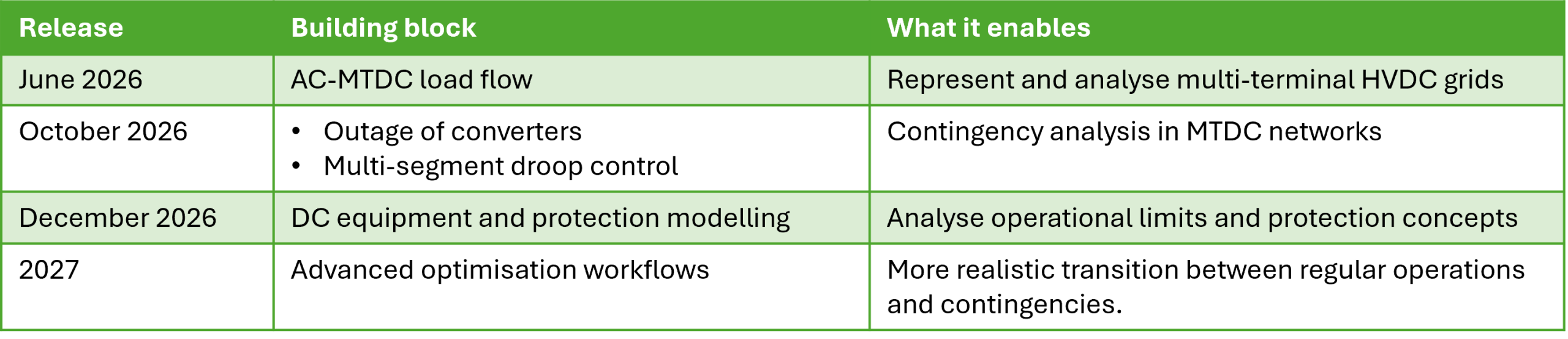
PowSyBl MTDC roadmap
The capabilities introduced in this release are part of a broader roadmap aimed at progressively building the foundations required for future AC/DC planning, security and interoperability studies within a common open-source environment.
Join the DC-BL community!
As Europe prepares for multi-terminal and multi-vendor HVDC infrastructures, new methodologies and tools will be needed to assess the resilience of these new networks. DC-BL provides a collaborative framework to develop and validate these capabilities within an open-source ecosystem.
- Want to learn more about the DC-BL initiative and its partners? Visit the dedicated DC-BL page for additional information about the project objectives, governance and collaboration framework!
- Interested in AC/DC grid studies, HVDC interoperability or future MTDC planning methodologies? Contact our team to discuss the DC-BL initiative and collaboration opportunities!
With the support of the French Agence Nationale de la Recherche, agreement ANR-10-IEED-0005-01.