

Packaging of 10 kV SiC MOSFETs: Trade-Off Between Electrical and Thermal Performances

2021-08-11T16:57:19+02:00October 25th, 2018|Electronique de puissance & convertisseurs, Publications|

SiC transistors can achieve blocking voltages of 10kV and more. This makes them especially attractive for energy transmission and distribution. Although SiC devices can in theory operate at high temperature (more than 200°C), the on-state resistance of SiC MOSFETs exhibits a strong dependency on the junction temperature. As a consequence, it is shown that these transistors must actually operate at a relatively low junction temperature (less than 100°C) to increase conversion efficiency and prevent thermal runaway. This requirement for high-performance cooling systems has consequences on the packaging technology: the corresponding power modules must both offer a high voltage insulation and a low thermal resistance. In particular, there is a trade-off in the thickness of the ceramic substrate located between the SiC devices and the cooling system. We propose a new substrate structure, with raised features, which improves the voltage strength of a substrate without increasing its thickness. This structure is demonstrated experimentally.

Energy Control of Modular Multilevel Converters in MTDC Grids for Wind Power Integration

2021-08-11T16:57:29+02:00October 18th, 2018|Architecture & systèmes du supergrid, Publications|

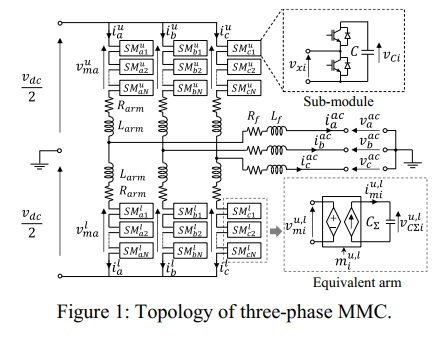
The role of Modular Multilevel Converters (MMCs) in HVDC grid greatly differs depending on whether it is an offshore or an onshore station. From the common point in their control schemes, an unexploited ability of the MMC—the controllability of the internally stored energy—is identified in both offshore and onshore applications. The virtual capacitor control, previously proposed by the authors, makes use of this degree of freedom to provide energy contribution to the DC grid. The impact of this control is demonstrated by time-domain simulations of a five-terminal HVDC grid.

HVDC protection criteria for transient stability of AC systems with embedded HVDC links

2024-10-09T10:47:04+02:00October 15th, 2018|Architecture & systèmes du supergrid, Publications|

The objective of this study is to propose a methodology for the transient stability assessment of a simple but representative AC grid in case of DC fault. After validation of the methodology, some HVDC link protection criteria are defined in terms of the Critical Time to Return to Operation. These criteria will be helpful for the design of HVDC protection systems or for the sizing of future HVDC links in order to respect the constraints of the existing protection strategies.

Design considerations for the 2- phase cooling system of a 5 MW MVDC converter

2021-08-11T16:57:57+02:00October 11th, 2018|Electronique de puissance & convertisseurs, Publications|

This presentation will provide an update on our current project: designing a cooler for a high power (5 MW) MVDC converter for offshore wind turbines applications. A number of constraints are imposed, mainly related to a limited volume, environmental, safety and health regulations, and of course cooling performance. Indeed, as we presented last year (ATW 2017), the silicon carbide power semiconductors used in this converter should operate at a junction temperature lower than 100 °C for better efficiency.

Measurement and Analysis of SiC-MOSFET threshold voltage shift

2021-08-11T17:37:46+02:00October 4th, 2018|Conference, Electronique de puissance & convertisseurs|

Gate-oxide technology weakness is a main reliability issue of Silicon Carbide MOSFET transistors. The threshold voltage shift is a critical phenomenon that addresses the reliability of industrial power applications. It is important to have a better understanding of the phenomena implied in the gate threshold voltage shift. In this context, HTGB test is proposed and the resulting gate oxide stress is studied and discussed in this paper.

Go to Top