A novel single-ended fault identification algorithm for full selective protection strategy
We propose a parametric single-ended fault identification algorithm to be used in full selective protection strategy.
This paper aims at the detection and characterization of partial discharges (PD) in GIS under HVDC constraints in the presence of a protrusion/metallic particle on the high voltage conductor.
Recent studies have demonstrated that fluoronitrile (FN) NovecTM 4710 and fluoroketone (FK) NovecTM 5110 show higher dielectric strength than SF6. These gases can be mixed with a buffer gas such as CO2 and technical air to have suitable dielectric properties for high voltage insulation applications.
This paper gives an overview of electrical DC phenomena in GIL/GIS, the influence of insulating properties of SF6 and filled epoxy resin, and design of new support insulator for 320kV HVDC GIL/GIS. The busbar system including the insulator was designed not only to satisfy all standard requirements such as mechanical, temperature rise, heating cycle performance but also particular requirements for HVDC applications such as superimposed impulse tests. Finally and for the first time at actual scale, type test according to CIGRE JWG D1/B3.57 was conducted in EDF R&D Les Renardières laboratory to verify the design and insulating performance of the 320kV HVDC GIL/GIS system. The satisfactory results allow to confirm the high technology readiness level of HVDC GIL/GIS.
Power electronic traction transformers (PETT) are multilevel AC/DC on-board converters, studied for railway applications to replace traditional solution with low frequency transformers. This paper focuses on the insulated DC/DC converter in a PETT. Three variants of resonant single active bridges (R-SAB) with 3-level NPC primaries are optimised to maximise the efficiency, under mass and dimension constraints. They are sized and compared for a 2 MW PETT on a 15 kV/16.7 Hz railway infrastructure, using 3.3 kV SiC MOSFETs and nanocrystalline C-core transformers with cast resin insulation and forced air cooling. The highest efficiency at nominal power, 99.17 %, is reached for a configuration with a 3-level full bridge NPC primary, a 2-level full bridge secondary, and a 32.1 L/49.1 kg transformer operating at 6 kHz.
This paper evidences the influence of different parameters on the electric field on DC spacers in GIS/GIL and thus their dielectric withstand under S/IMP tests. A notable difference in term of electric field can be observed in function of impulse polarity, load condition (with/without heating current) and insulating material’s properties. For example, an overstress of 0.3pu was obtained on spacer’s surface in case of superimposed impulse test with opposite impulse polarity, high load condition and high leakage current in gas. Contrary to AC system where the simple LI tests were enough, S/IMP tests with both impulse polarity, ZL and HL conditions are mandatory to verify the insulating performance of HVDC GIS/GIL spacer. This paper gives a better understanding of the electric field distribution in HVDC GIS/GIL and helps for the design and tests
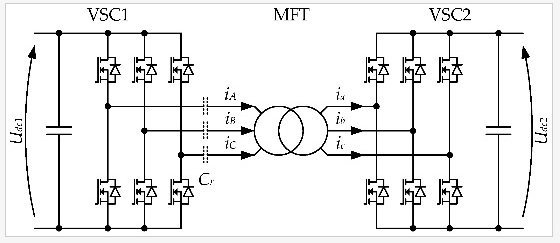
The article presents a three-phase Medium Frequency Transformer being a part of a 100kW 1.2kV 20kHz Dual Active Bridge DC-DC converter. The transformer design is detailed focusing on winding and core power loss calculation. The high power three-phase MFT prototype is presented. The experimental results include the transformer impedance characteristics, no load test and three-phase DAB full load test waveforms.
This article proposes a methodology of Cost-Performance Assessment (CPA) enabling the efficient cost evaluation required for the Cost-Benefit Analysis (CBA). The proposed method is applied for the Modular Multilevel Converter (MMC) in offshore wind high voltage direct current (HVDC) transmission. Thanks to the developed model, an analysis of submodule voltage rating is performed demonstrating the interest of this methodology in the evaluation of new technologies for HVDC transmission. The analysis shows that increasing the submodule (SM) voltage could lead to savings in the MMC cost and weight.
The number of high voltage direct current (HVDC) links continue to increase over the years, most of them, for offshore applications or bulk power transmission over long distances. The present paper evaluates the possible development of a direct current (dc) grid in Europe given the present, and future, HVDC links. Eight potential cases for the interconnection between close links are suggested as starting scenario for a multiterminal network. The need of a dc-dc converter and its special requirements are evaluated in function of suggested interconnections. As an example, a case study is chosen to evaluate the behavior of an interconnection between line commutated converter (LCC) and voltage source converter (VSC) link using a front-to-front (F2F) isolated converter.
This paper deals with the opportunities to introduce split storage into an MMC. The analysis is focused on the internal energy exchange to maintain the proper function of the converter by using circulating current. Analysis shows that, SM capacitor voltage ripple or semiconductors load are greatly influenced by additional circulating current injection. This study helps to design Embedded ESSs in the converter to provide new function like ancillary services for power system operation. Finally, a simulation of an MMC with ESS confirms analytical calculations.