Unidirectional thyristor-based DC-DC converter for HVDC connection of offshore wind farms
This paper introduces a unidirectional MVDC-HVDC converter for ‘all DC’ connected offshore wind farms.


This paper introduces a unidirectional MVDC-HVDC converter for ‘all DC’ connected offshore wind farms.
This paper investigates the gate-driver design challenges encountered due to the fast switching of wide band-gap semiconductors (here, SiC MOSFETs) in the half-bridge configuration.
The experimental studies show the effects of the transformer construction and vector group (star/delta) on the common-mode currents through the gate drivers of SiC MOSFETs in a 100kW 1.2kV three-phase dual active bridge converter.
In this paper, a methodology is proposed to define the optimal rated power and number of PEBBs.
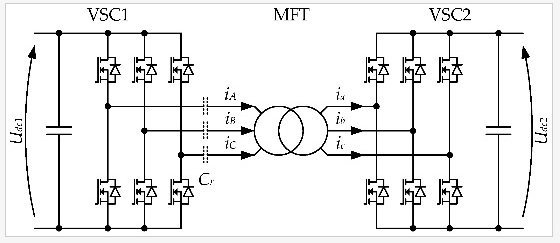
This article presents the measurements of the equivalent B(H) and the equivalent magnetic permeability of two three-phase MFT prototypes.
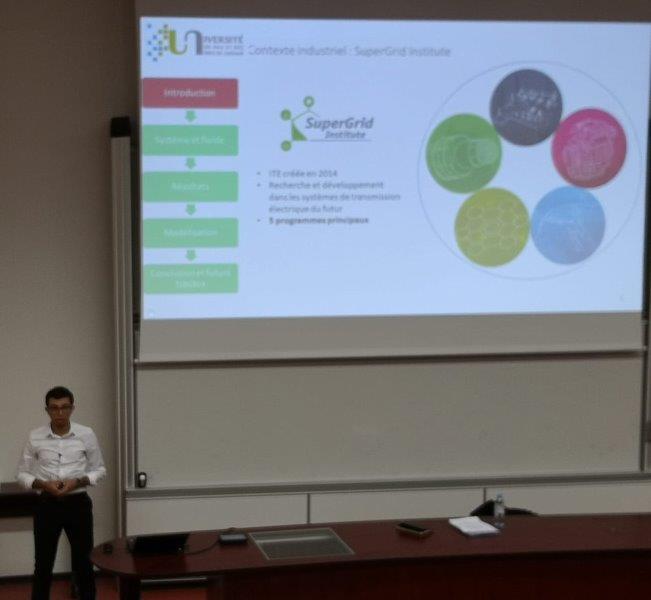
The work of this thesis focuses on the experimental development of a passive and biphasic cooling system to cool down power electronics. Some of those modules are mean voltage power converters developed by Supergrid Institute. Some constraints have been imposed upstream to this project. While some limitations are of the technological nature, other constraints are related mainly to the environmental and biological aspects. The first part of this thesis was to find a suitable cooling system that could be adapted to the project specifications. After some research, we decided to build a loop thermosiphon filled with NOVEC 649.
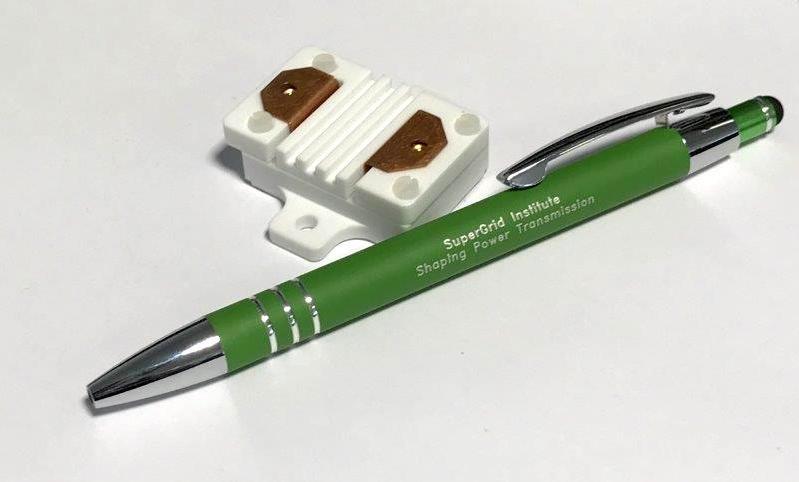
SuperGrid Institute has achieved a major milestone in the development of 10 kV Silicon Carbide (SiC) devices such as 5A BJT and 50A PIN diode as part of its work on developing innovative solutions for MV converters. Recent tests revealed outstanding switching performances.

SuperGrid Institute wishes you an electric new year! [...]

In order to include large-scale renewable sources into the electrical system and to transport high amounts of energy through long distances, the actual AC grid must be upgraded. HVDC transmission grids appear as a promising solution to upgrade the system and answer correctly the future needs and requirements. The development of such grids can be done following two different approaches. For one side, a DC system designed totally from zero following a standardization of HVDC technology, and for the other side, an incremental evolution using the existing HVDC lines. The second approach seems more reasonable due to the reutilization of infrastructure, the inconvenient is that the technology used on each existing line is different. Thus, their interconnection will require DC¬DC converters as interface elements. These structures allow the interconnection of different HVDC schemes and offer more functionalities than only DC voltage adaptation like power flow control and protection.
Power electronic traction transformers (PETT) are multilevel AC/DC on-board converters, studied for railway applications to replace traditional solution with low frequency transformers. This paper focuses on the insulated DC/DC converter in a PETT. Three variants of resonant single active bridges (R-SAB) with 3-level NPC primaries are optimised to maximise the efficiency, under mass and dimension constraints. They are sized and compared for a 2 MW PETT on a 15 kV/16.7 Hz railway infrastructure, using 3.3 kV SiC MOSFETs and nanocrystalline C-core transformers with cast resin insulation and forced air cooling. The highest efficiency at nominal power, 99.17 %, is reached for a configuration with a 3-level full bridge NPC primary, a 2-level full bridge secondary, and a 32.1 L/49.1 kg transformer operating at 6 kHz.
S’inscrire à notre newsletter :
Rejoignez-nous
Dans notre newsletter trimestrielle, nous partageons des informations sur nos derniers projets, produits et services et indiquons les prochains événements où vous pouvez nous trouver.
You cannot copy content of this page