Performing semiconductor condition health monitoring
for predictive maintenance with Alstom
Alstom, a global leader in rail mobility solutions, partnered with SuperGrid Institute to tackle semiconductor condition health monitoring (CHM) for its onboard converters through the POWERDIAG project, supported by the French National Research Agency (ANR) as part of the “Investissements d’Avenir” Program. Implementing predictive maintenance for power semiconductors in rail applications enables maintenance optimisation, a reduction in costly train downtime, and enhanced availability of traction chains. In this project, several components were tested on our purpose-built CHM test bench, and the results used to produce practical tools for semiconductor lifetime prediction.
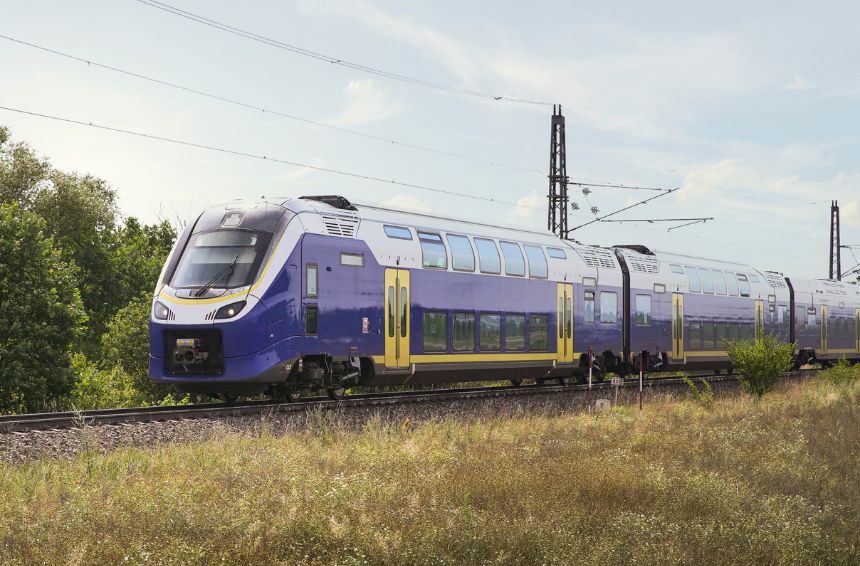
Copyright © ALSTOM SA 2024. Tyler Vesneski – LNVG – Coradia Max™
The challenge: optimising maintenance for rail power electronics equipment
Reducing life-cycle costs and improving the sustainability of power electronics are strong drivers for developing condition and health monitoring approaches for railway power electronic systems. These approaches aim to improve system availability while enabling more efficient and targeted maintenance.
Unexpected semiconductor failures cause expensive repairs and service disruptions for end-users. Therefore, being able to predict the lifetime of semiconductors, the most critical component in the power chain, is crucial to enable proactive maintenance and a fluid train service.
Developing these smart maintenance approaches requires robust lifetime models, tools and methodologies. Specialised equipment is needed in order to conduct accelerated aging tests that accurately reproduce the stresses encountered in real operating conditions. Performing the long and time-consuming reliability tests while tracking relevant degradation indicators was challenging for Alstom. That’s where SuperGrid Institute came in.
SuperGrid Institute’s services: semiconductor aging tests
At SuperGrid Institute, we crafted a test plan to evaluate the influence of different parameters on the reliability of semiconductors, analysing key indicators such as the variation in junction temperature and the number of thermal cycles to failure.
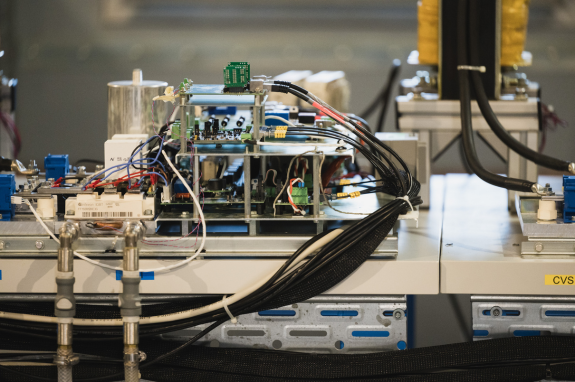
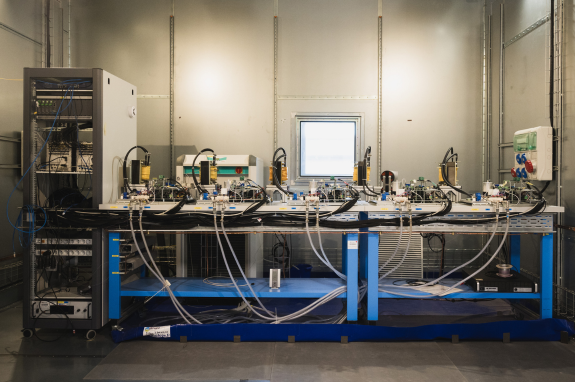
In the first phase, we tested silicon IGBTs (rated 1.2 kV, 150 A) on a custom AC power-cycling test bench which provides a more realistic testing environment than other standard test benches. Unlike standard DC test setups, our test bench enables the components to experience both conduction and switching losses along with high voltage constraints.
With 5 identical converters tested simultaneously, and devices tested up to real failure, we were able to validate outcomes from multiple sources to provide statistically relevant results.
The phase one results were promising enough to launch to a second phase in which we will test rail-grade silicon IGBTs and SiC MOSFETs. The collaboration for this phase is ongoing.
© Jérémie Morel
Key results: tools for semiconductor condition health monitoring
- Monitoring boards capturing real-time semiconductor health data.
- Online estimation of the semiconductor devices’ junction temperature.
- Aging database with electrical measurements across different stress scenarios.
- Lifetime models and algorithms to calculate devices’ remaining useful lifetime.
These tools deliver dynamic predictions of semiconductor lifetimes and facilitate a shift towards data-driven predictive maintenance, which in turn enables more reliable, efficient rail operations.
Contributing to scientific literature on condition health monitoring
The subject of semiconductor health monitoring is a hot topic! Our collaboration with Alstom on this project resulted in two papers presented at PCIM 2026:
- Lifetime of IGBTs Under Mixed Sequential Power Cycling: A Matched-Lifetime Sequencing Experiment – Diego Velazco (SuperGrid Institute) – Winner of the Best Paper Award!
- Estimating Semiconductor State of Health and Remaining Life Using Statistics and Digital Twin Model – Emmanuel Batista (Alstom)
We are delighted to count Alstom among our loyal customers and to assist them in their development and innovation efforts!
Want to know more about our work on power electronics?
The POWERDIAG project is supported by a grant of the French National Research Agency (ANR) as part of the “Investissements d’Avenir” Program (ANR-10-IEED- 0005)