

Advancing AC-DC simulation with multi-terminal DC load flow in PowSyBl
Europe’s power system is shifting from point-to-point HVDC links to multi-terminal DC (MTDC) schemes, embedded in an increasingly meshed AC grid. Anticipating how these hybrid AC-DC systems behave under contingencies, and planning their extension, requires simulation tools that today’s landscape does not yet fully provide. CRESYM’s DC-BL project, launched in January 2026, addresses this gap by building open-source MTDC capabilities into PowSyBl. SuperGrid Institute is proud to announce the first contributions to this project have been delivered!
From point-to-point HVDC to multi-terminal DC grid simulation
The massive integration of renewables, the rise of multi-terminal HVDC schemes, and the growing complexity of the European power system require robust network behaviour simulation tools. Transmission System Operators (TSOs) increasingly need to anticipate power systems' responses to contingencies and to plan grid extensions involving both AC and multi-terminal DC infrastructures. This is essential to characterise the operating envelope of MTDC networks and to design control mechanisms that handle their constraints.
While several tools exist for load flow and optimal power flow (OPF) studies, their AC-DC capabilities are usually limited to point-to-point HVDC links and lack detailed models for AC-DC converters. Mature, interoperable AC-DC modelling with multi-terminal DC networks is still lacking. Current practices do not yet ensure multi-vendor interoperability – a known challenge when combining converters and control schemes from different manufacturers in hybrid AC-DC grids with MTDC subnetworks.
Achieving a shared understanding of AC-DC interactions is becoming a strategic necessity, and it calls for tools that are easily auditable, extensible to follow evolving practices, ready for large scale studies, and that can accurately represent realistic industrial grids end-to-end. High-performance open-source software can provide the solution.

The DC-BL project: exploring the potential of PowSyBl for AC-DC simulation models
DC-BL (DC BLocks) was set up by CRESYM, a non-profit organisation promoting collaborative R&D to develop open-source energy system simulation tools. The project is implemented by SuperGrid Institute, with TenneT Germany and TenneT Netherlands as TSO partners and remains open to additional partners. Launched in January 2026, the project explores PowSyBl (Power System Blocks) as a common, open-source and extensible simulation framework for AC-DC models with MTDC subnetworks.
PowSyBl has a permissive open-source license*, which promotes transparency while enabling the creation of bespoke tools and the ability to run many computations in parallel, without the hindrance of license constraints.
PowSyBl natively supports CIM/CGMES formats, enabling consistent and interoperable data exchange between TSOs across Europe. Governed under LF Energy, PowSyBl benefits from a transparent, neutral governance model where an open Technical Steering Committee publicly reviews changes and sets the roadmap. The framework is already used operationally by several European TSOs and Regional Coordination Centres (RCCs), reinforcing its suitability as a shared foundation for developing advanced AC-DC modelling capabilities.
*Open source software is software released under a license that allows sharing and modification of source code, under the specific conditions of the license.
First contributions: AC-DC load-flow and DGS import
SuperGrid Institute has reinforced its architecture and system program by constituting a software team dedicated to extending PowSyBl with MTDC capabilities. They develop and validate the required code for each new feature for the simulation tool. It is this team that has been working on the DC-BL project.
Our first delivered features integrated into PowSyBl make it possible to run coupled MTDC and AC grid load flow simulations. This development was essential in order to handle MTDC networks in the framework's security analysis features. This new feature will help users design complex networks using equipment from multiple vendors, a key step towards interoperability. The integration of this first deliverable proves that the PowSyBl community recognises our work as being relevant and meeting the quality standards necessary to contribute to the software.
We also developed a solution to enable the import of MTDC model data in the DGS format – a format used by a widely-adopted proprietary grid modelling tool (DIgSILENT PowerFactory) – thereby lowering the barrier for users migrating reference cases into PowSyBl.
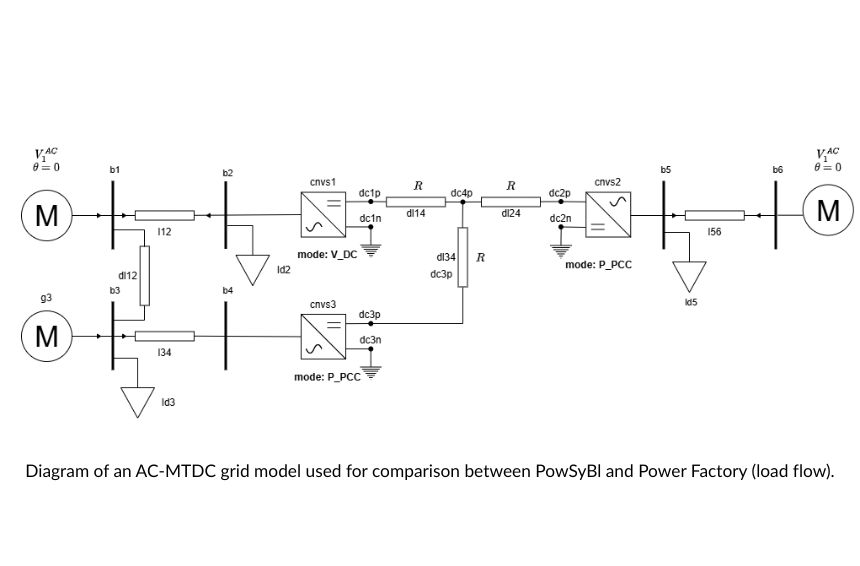
The DGS format import made an initial comparison between PowSyBl and PowerFactory possible. It covers monopolar and bipolar HVDC links, either embedded inside a master AC network or connecting two asynchronous AC networks – a configuration representative of an offshore wind farm connected to a continental grid. On the test cases run so far, numerical results agree within the expected tolerances. Further validation campaigns on larger and more diverse cases are under way.
Next steps – even more simulation capabilities
In the coming months, we plan to extend the validation of the MTDC numerical models, broaden the set of supported equipment, and demonstrate operational relevance through a prototype security analysis tool built on the new library features. Together, these deliverables will pave the way for the DC-BL roadmap, which includes AC-DC grid equivalents and OPF capabilities in 2027, and dynamic simulation of hybrid AC-DC grids in 2028.
Join us in shaping the future of AC-DC grid simulation
It is still possible to join the DC-BL project as a partner if you are interested in shaping a shared open-source foundation for AC-DC grid simulation. Learn more about the project and how to join on the CRESYM DC-BL page, and follow PowSyBl's MTDC developments on the PowSyBl website.
Want to know more about PowSyBl & how open-source can enhance AC-DC grid simulation? Get in touch with our dedicated software team to see how we can help you!